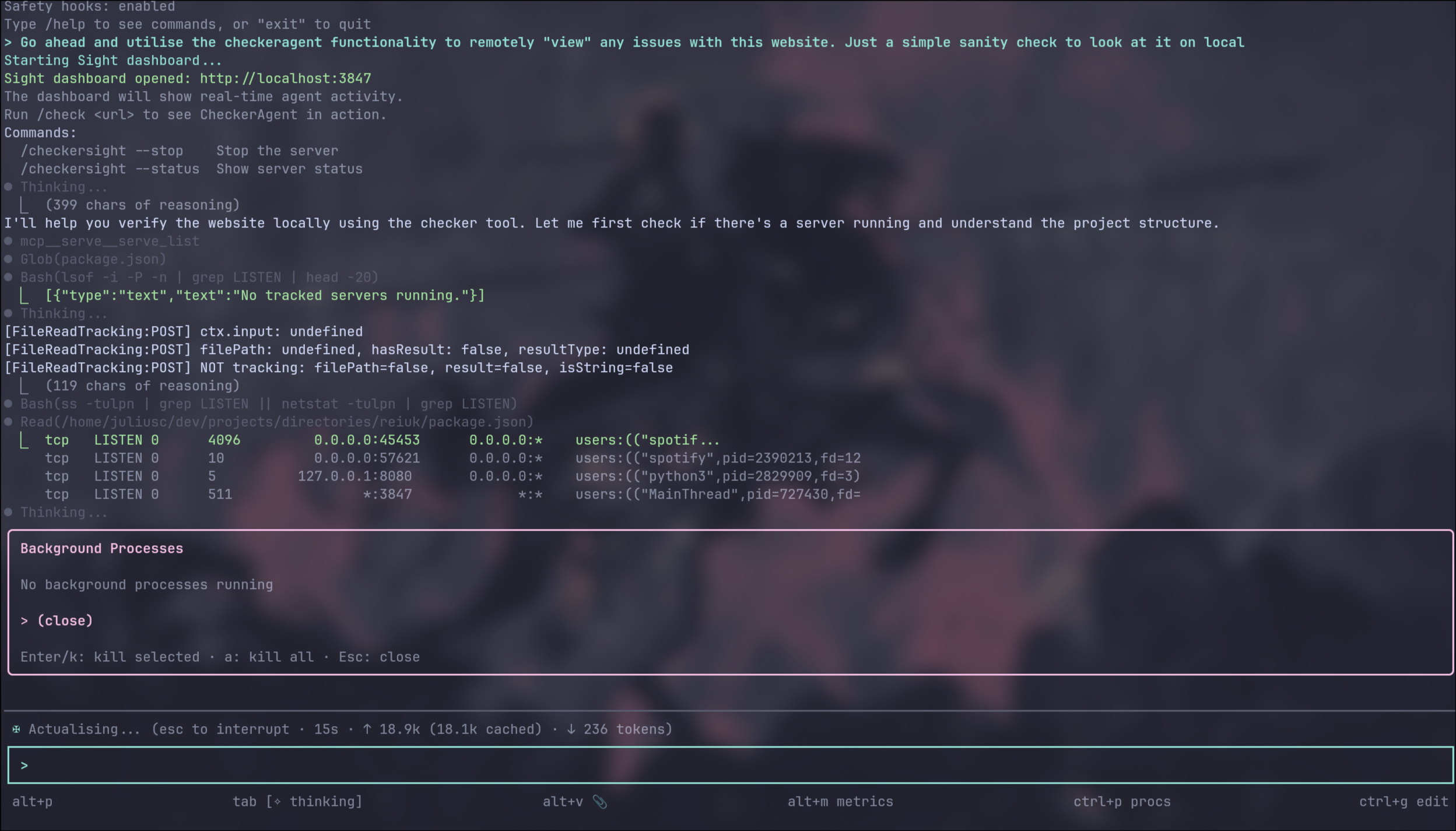
My workflow with REI has a repetitive pattern: generate code, load it up locally, hit an error, copy the error message, paste it back into the CLI with "pls fix," and repeat until it works. It's effective, but tedious. POWC mode automates that entire loop.
The Verification Loop
POWC stands for Produce Only Working Code. When this mode is enabled, REI automatically runs the generated code through the Checker Agent after every modification. If there's a build error, a type error, or a runtime exception, REI sees it immediately and attempts to fix it. No manual copy-paste required.
The loop continues until the code actually runs, or until REI hits a wall it can't solve on its own. In practice, this eliminates the most tedious part of AI-assisted coding: the back-and-forth of "here's the error, now fix it." REI just does that automatically while I work on something else.
Unified Checker Agent
The Checker Agent from v0.11.0 was split into different implementations for different contexts: one for CLI projects, one for web services, one for APIs. This was a mistake. Different validation strategies, yes, but the same interface and the same guarantees.
Now there's a single Checker Agent that dispatches to appropriate validation strategies based on project type. More consistent behavior, less surface area for bugs.
Process Management
Problem I didn't anticipate: when REI spawns development servers, test runners, or build processes, those processes can outlive the REI session. Worse, they hold onto ports and cause conflicts when you start a new session. So now there's proper process lifecycle management.
Ctrl+Popens a process management menu showing everything REI has spawned- Orphan detection finds and offers to kill zombie processes from previous sessions
- Server startup automatically cleans up dead processes holding the target port
POWC mode is opt-in for now. I need more testing before I'm comfortable making it the default. But the recursive self-correction architecture is in place, and I'm using it for all my own development.