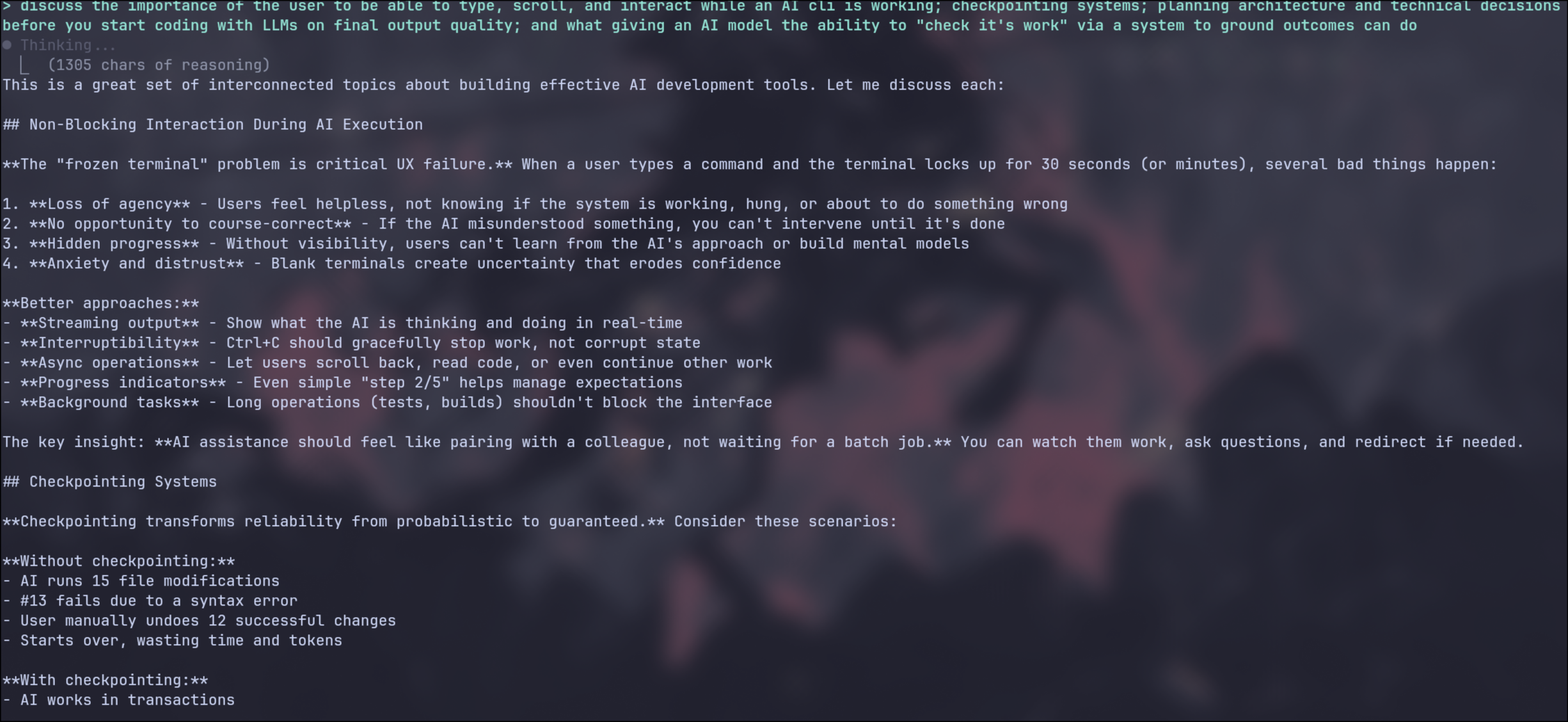
REI stops being a clever prototype here and starts being a production tool. I've spent the last week rebuilding nearly everything: the UI, the agent architecture, state management. I'm proud of where it landed.
The UI Problem
Terminal applications have a fundamental tension: you want real-time output streaming, but you also need the user to be able to type, scroll, and interact while that output is happening. Most CLI tools punt on this. They block input during generation, or they let scrollback get corrupted. I've rebuilt the entire rendering layer using Ink, which brings React's component model to the terminal.
Now you can type while REI is generating. Scrollback stays clean. The cursor doesn't jump around. Sounds minor, but spend a few hours in a tool and these details compound into the difference between productive and painful.
Checker Agent
AI-generated code looks right more often than it is right. The Checker Agent is my answer. Three modes: turbo for quick sanity checks, standard for typical validation, thorough for when you're about to ship something important.
Unlike a linter, the Checker Agent understands intent. It knows what you asked REI to build and verifies that the implementation actually achieves that goal. It catches logical errors that pass syntax checks. It identifies when generated code solves a slightly different problem than the one you specified.
VisionStage
VisionStage is a multi-agent pipeline that transforms a rough idea into an executable implementation plan. You describe what you want to build in plain language, and a sequence of specialized agents refines it into architecture decisions, technology selections, and modular work packages.
The pipeline runs through nine stages: ConversationBot extracts requirements through dialogue, ExistingProductDevourer researches competitors and open-source alternatives, AlphaIdea synthesizes a concrete tech stack, and subsequent stages handle component architecture, risk assessment, and module decomposition. Each agent builds on the previous one's output, and the system pauses for user decisions at critical junctures.
VisionStage is REI's first real multi-agent system. Getting the coordination right took longer than building any individual agent. State management between agents, handling user interruptions mid-pipeline, tracking token usage across the whole thing.
Time Travel
Every significant state change is now checkpointed. The /rewind command lets you jump back to any point in your current session. The /kronos command takes this further: cross-session time travel, letting you recover work from previous days if you need to.
The implementation handles file state, conversation context, and even terminal display state. When you rewind, it's not just resetting a counter. It's reconstructing the entire working environment as it existed at that checkpoint.
MCP Hub and RIPER Modes
The Model Context Protocol hub lets REI connect to external tools and services: databases, APIs, custom integrations. RIPER modes give you fine-grained control over what tools REI is allowed to use during a conversation. Sometimes you want full autonomy; sometimes you want to restrict modifications while you're thinking through an approach.
Everything that comes next builds on this architecture.